Editor’s Note: This is the first of four articles we will publish on the two Democratic and two Republican candidates vying in primaries for the NY-21 open seat. NY-21 is a huge New York congressional district spanning the North Country and west into parts of Central New York. The primary is June 23.
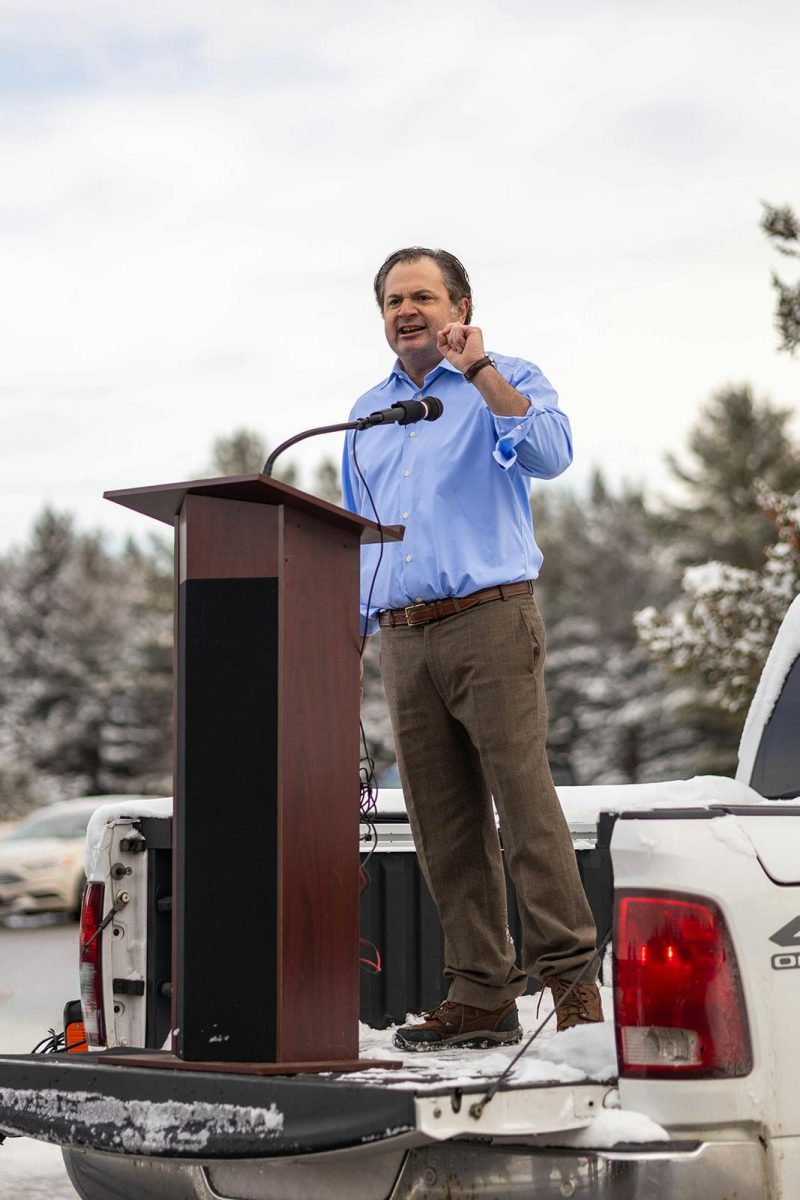
Blake Gendebien, a second-generation dairy farmer from Lisbon, NY, is running as the Democratic frontrunner seeking to flip New York’s 21st Congressional District. Republicans have held the seat for over a decade, ahead of the June 23 primary.
Gendebien, who said he has logged over 125 campaign events across the sprawling North Country district since November 2024, is campaigning on lowering costs and preserving rural healthcare access in a region where, he said, two hospitals have filed for bankruptcy and nearly half the electorate is over 65 years old.
Gendebien was among the first Democrats to enter the race after President Donald Trump nominated Rep. Elise Stefanik as U.S. Ambassador to the United Nations. Trump later withdrew the nomination, but Stefanik announced in December she would not seek a seventh term in Congress, leaving the seat open.
“We’ve been at this for 18 months now,” said Gendebien. “Since November of 2024, we hired our first staffer before Thanksgiving in 2024.”
Democratic candidates Dylan Hewitt and Maylon Haller have since dropped out, leaving Lake Placid restaurant owner Stuart Amoriell as his only remaining primary opponent. Gendebien says his sights are already set on the general election.
“Our focus is on Anthony Constantino, who’s going to win that Republican primary,” Gendebien said. “Our focus is on delivering for the North Country, lowering costs, saving our rural healthcare, and making sure we end the dysfunction in Washington.”
Gendebien grew up on a farm in Lisbon after his parents bought it upon returning from the Peace Corps in Bolivia in 1972. He earned a bachelor’s degree from Penn State and spent time working for a tractor manufacturer in Atlanta before his father called with news that the farm next door was for sale.
“We bought a rundown place with tremendous potential,” Gendebien said. “That’s what I’m good at, solving problems and seeing potential in something that can become fantastic. That’s what I want to do with New York’s 21st District.”
He and his wife, Carmen, a Cuban immigrant who fled communism as a child, returned to the North Country and built the operation into a 1,200-acre farm with 500 cows and 1000 cattle overall. Before launching his congressional campaign, Gendebien served as vice chairman of the Agri-Mark cooperative board, the farmer-owned cooperative behind the Cabot cheese brand, and as president of the Lisbon Central School Board.
For Gendebien, rural healthcare is one of the most pressing issues facing his district. He points to the recent bankruptcy filings of two North Country hospitals as evidence of worsening issues.
“We have two hospitals that just filed for bankruptcy, Claxton-Hepburn and Carthage,” Gendebien said. “That’s a view into the crystal ball of what’s going to happen when Medicaid cuts come in November.”
The issue is personal for Gendebien. He described driving his uncle Rodney, who had suffered a stroke, two and a half hours to Syracuse for routine doctor’s appointments, a reality that shouldn’t be this common for North Country residents, he said.
“If we lose our hospitals, we don’t just lose healthcare, we lose incredibly good-paying jobs,” he said.
Beyond healthcare, Gendebien says the rising cost of living is heightening economic anxieties across the district.
“I know what it’s like to afford groceries for three hungry boys when you’re starting a family,” said Genebien. “I know what it’s like to try to buy your first home in this district.”
Gendebien said Washington has failed to keep pace with the financial pressures facing the region’s most vulnerable residents.
“These are veterans and seniors,” he said. “We need to make sure inflation is not outpacing their pensions, and we need to make sure they can get healthcare immediately when they need it.”
As a working farmer, Gendebien feels the pressures firsthand.
“Our prices have gone up. Fuel, fertilizer, gasoline, everything is harder.”
If you ask Gendebien, the rising cost of living is the product of partisan gridlock. Residents of the district, regardless of party affiliation, are feeling the economic pressures.
“People feel like Washington has completely forgotten us, and they have,” he said.
He argues that politicians have prioritized their own interests over those of their constituents, and that the North Country has paid the price.
“People feel like politicians are out for themselves, to enrich themselves and make their wealthy friends wealthier,” Gendebien said. “We need policies that lift up everybody in this district.”
Gendebien said the answer is not more partisan fighting but solutions that cross party lines.
“My friends and neighbors are looking for solutions, not attacks on people on the other side of the aisle.”
Gendebien concedes they can’t win in November without crossing party lines. His pitch to Republican and unregistered voters is simple. It’s not about policy, and it’s about helping your neighbor.
“When my neighbor’s barn collapsed, I helped milk their cows. I didn’t care if they were Democrats or Republicans. That’s what people are starving for here.”
Gendebien said the negativity coming from the Republican primary has only reinforced his approach.
“I’m going to run this campaign like farmers run their farms: with hard work, grace, and dignity,” he said. “That doesn’t mean I’m a doormat. It doesn’t mean I’m going to roll over.”
He argued that his platform is not a partisan one and that the issues he is running on should resonate with all residents, spanning party lines.
“Since when is supporting veterans and seniors divisive?” Gendebien said. “Since when is lowering costs divisive? Since when is saving rural healthcare divisive? They’re not.”
And when it comes to Republican farmers, the backbone of the district’s agricultural economy, Gendebien says he is on familiar ground.
“Most farmers in the district are Republicans,” he said. “Farmers are my wheelhouse.”
With the June 23 primary weeks away and the general election set for November 3, Gendebien said as a farmer, he is not slowing down. He described being out planting alfalfa, peas, and oats the days before his interview at the Legislative Gazette.
For Gendebien, it is not a bad metaphor for the campaign itself.
“As a farmer, I know how to get to work,” he said. “There’s no time for distractions and no time for things that are not productive. Name-calling and political partisan garbage don’t get anything done.”
The primary is June 23. The general election is November 3.