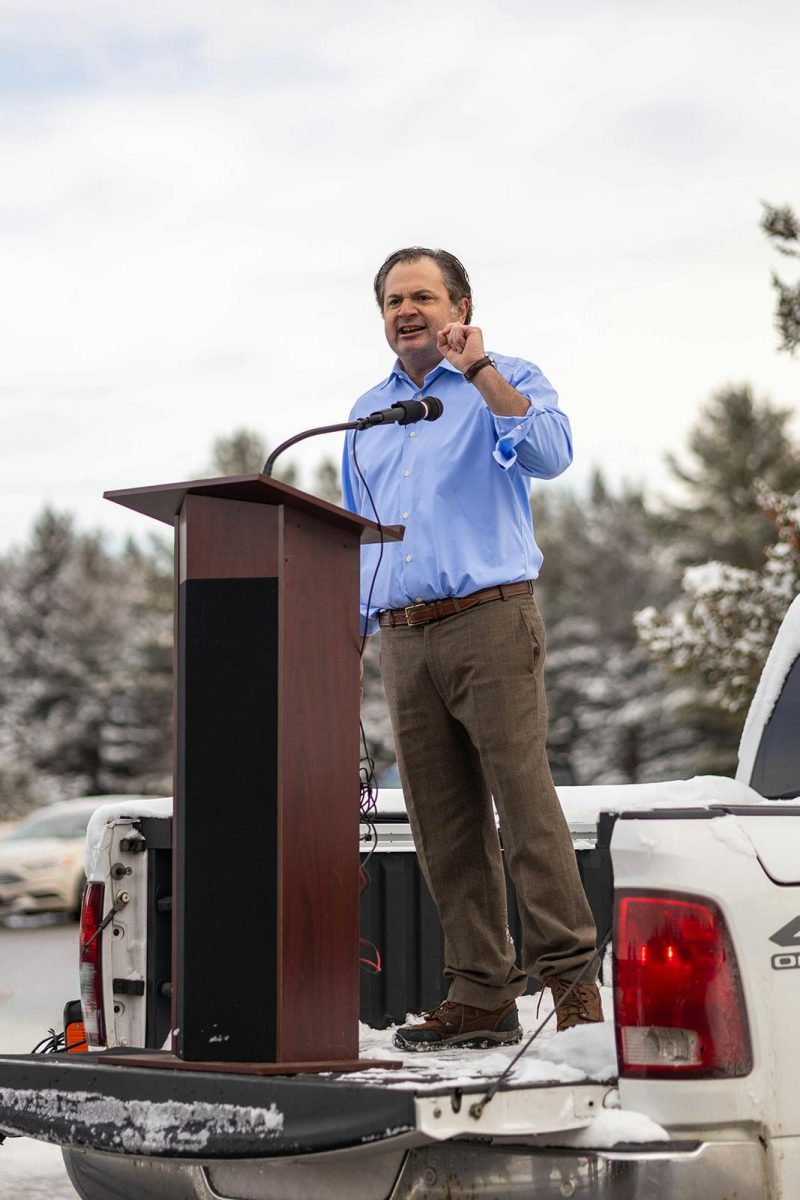
Six months ago, Lake Placid restaurant owner Stuart Amoriell had no political ambitions, no campaign infrastructure, and no plans to run for Congress. Then one of his employees was deported.
Amoriell, 49, owner of The Pickled Pig in Lake Placid, is running as the underdog Democratic candidate seeking to represent New York’s 21st Congressional District. He entered the race in December, months behind his primary opponent, Lisbon dairy farmer Blake Gendebien, who had been campaigning since November 2024.
With the June 23 primary weeks away, he is making a personal case that voters, not party insiders, should decide who takes on the Republican nominee in November.
“It’s not enough to be frustrated,” Amoriell said. “You have to stand up and do something.”
Amoriell realized he had to stand up when Emmanuel, one of his employees, was stopped by ICE. Emmanuel, a young Venezuelan man, was authorized to live and work in the United States. He had his paperwork. They arrested him and told him to sign a self-deportation order or be sent to a prison in El Salvador.
Emmanuel refused. Amoriell hired an attorney. He was told it would be nearly a year before an immigration judge would hear the case, and that Emmanuel would remain detained in Batavia in the meantime.
“Here’s this 20-year-old kid, scared to death,” Amoriell said.
Emmanuel ultimately signed the order. He was sent to Texas, put on a plane, and returned to Venezuela.
“We are supposed to be a nation of laws, a nation of values,” said Amoriell. “Here is somebody who followed the system, had his documentation, and was intimidated into signing an agreement that allowed our government to deport him.”
When it comes to immigration policy, Amoriell does not want to pin the issue along party lines. He is critical of both parties for decades of inaction.
“For decades, politicians on both sides recognized that immigrants were essential to agriculture, to business, to our communities,” he said. “But they decided it was not politically wise to create a pathway to citizenship.”
Amoriell wants voters to know he is in favor of strong borders, alongside a path for undocumented people who have built their lives in the U.S. to gain citizenship. He is careful to distinguish between the two.
“Absolutely, we want criminals out of this country,” he said. “We want strong borders. But we want smart immigration policy that gives a pathway to citizenship for those hardworking immigrants who have dedicated their lives to our communities, our schools, and our businesses.”
He frames the issue in economic terms as much as a moral issue.
“Smart immigration policy is America First,” said Amoriell. “We need immigrants to be part of our communities, working for our businesses, starting businesses. That is America First.”
Amoriell has lived in Lake Placid for a decade. He is the father of two girls. Being a father and a restaurateur, he said, gave him a front-row seat to the economic pressures facing North Country residents.
Amoriell has watched young people and families move to the North Country for work or to settle down. In many cases, he has also had to watch them pack up and move because they could not afford to stay.
“In Lake Placid or Saranac Lake, you’re looking at $1,500 to $2,000 for a studio apartment,” Amoriell said. “Utilities were hitting $1,500 this winter for normal-size apartments.”
Younger families, he said, are being priced out before they have a chance to put down roots.
“Without workers, without youth, without younger families, our communities are just going to get hollowed out,” he said.
Republican or Democrat, Amoriell says the rising cost of living is driving economic anxieties across the district for all residents.
“Your utility bill is not higher if you’re a Democrat and lower if you’re a Republican,” he said. “These quality of life affordability issues are an existential crisis for the North Country right now.”
Amoriell has a plan to address the cost of living. First, he wants the Trump tariffs repealed.
“It doesn’t take a Nobel Prize in economics to realize that if you increase the cost of goods coming into this country by 20, 30, 40, or 50 percent, those costs are going to be passed on to the consumer,” Amoriell said.
Second, he wants federal tax incentives and grants to steer developers toward workforce housing instead of high-dollar projects. Third, he wants universal healthcare.
“Healthcare is the number one cause of personal bankruptcy in this country,” he said. “We ultimately need a universal healthcare system so that everybody has the care they need at a price they can afford.”
He notes that 35 percent of the NY-21 district is on Medicaid, and that 30 percent of those residents are at risk of losing their coverage when Medicaid cuts take effect.
Democratic committee chairs across the district had aligned behind Gendebien during the anticipated special election that was called off after Trump withdrew Stefanik’s U.N. ambassador nomination. Stefanik later announced she would not seek reelection, formally opening the seat.
“They specifically asked me not to run,” he said. “They wanted not to have a primary. They just said, this is the candidate we selected. Let’s go with that.”
Amoriell refused. His petitions were then challenged, with nearly 900 of his more than 2,000 signatures called into question. The state Board of Elections reviewed the objections and confirmed he had enough valid signatures to remain on the ballot.
“I don’t think that’s how our democracy works,” he said.
Amoriell argues that when party insiders make decisions, people feel shut out and stop showing up.
“When the establishment is making the decision, a lot of voters feel like their voice is not being heard,” Amoriell said. “When they feel that way, they stay home on Election Day.”
For the 20 years before his campaign, Amoriell was an independent. He became a Democrat, he said, because the reality of the American political system left him little choice.
“This is a de facto two-party system,” he said. “To have a viable chance, you need to belong to either the Republican Party or the Democratic Party.”
He still calls himself an independent Democrat, a label he says reflects how he intends to govern.
“I don’t care whether somebody in our community voted for Stefanik or voted for Trump or was a Democrat,” Amoriell said. “My concern is the North Country. That is why I call myself an independent Democrat, and that is why I’m running for Congress.”
He points to Republicans and Democrats alike who are out driving senior citizens to doctors’ appointments, working on affordable housing, doing the things that Washington talks about but has not delivered.
Amoriell had been pushing for a debate since the start of the race. He wrote an open letter calling the debate “not merely a courtesy between candidates but an obligation we owe the people of this district.”
Gendebien has since agreed. A debate between the two Democratic candidates has been set for June 11, hosted by WRGB CBS6 with anchor Tom Eschen as moderator. It will be held before a small studio audience and aired in its entirety, unedited, on June 15.
For Amoriell, the confirmation was not just a scheduling win.
“A mailer or a press release is choreographed,” he said. “Voters learn a lot more by hearing a candidate on a stage, under pressure, in terms of where their positions actually are.”
After Gendebien accepted, Amoriell responded with a second open letter, this one striking a notably different tone. He wrote that by agreeing to debate, Gendebien had given voters “something no mailer, ad, or social post can: a fuller and more honest basis on which to make their decision on Election Day.”
He went further, pledging that when the primary is over, he would stand with whoever wins it.
“When this primary is decided, I will stand with the winner,” Amoriell wrote. “If the voters choose you, I will be proud to ask my supporters to rally behind your campaign.”
The primary is June 23. The general election is on November 3.