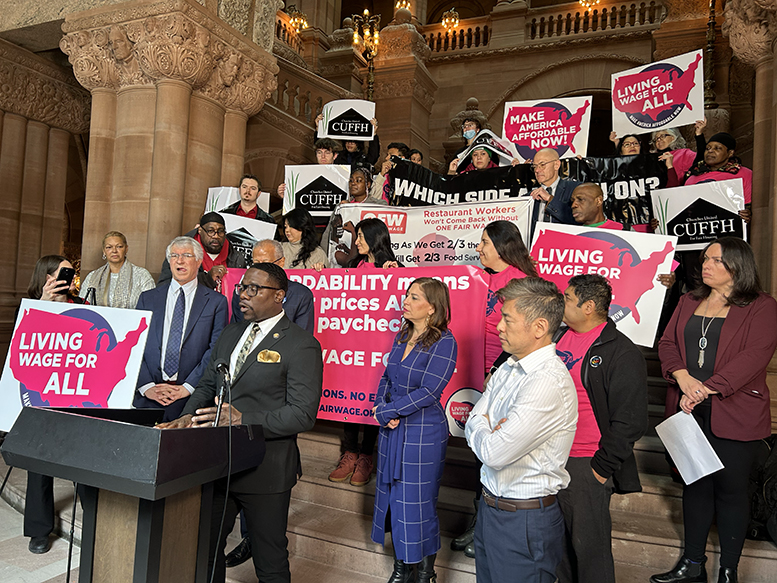
Lawmakers and advocates came together in the Capitol Building on Tuesday to support a package of legislation aimed at raising wages and making the state more affordable.
The rally, held by the organization One Fair Wage, was in support of several pieces of legislation, including tying the minimum wage to a living wage calculator as well as eliminating the sub-minimum wage and various exceptions to minimum wage. The legislation comes as the state navigates rising cost of living and Democrats across the country are running on issues of affordability.
“New York State, we’ve got to think about the cost of living. We’ve got to think about affordability as lifting paychecks,” said Steve Choi, lead for The Living Wage for All New York campaign. “So we are here today to say that New York State should be passing a minimum wage that is not the floor, but is a true living wage of $30 an hour.”
The Living Wage for All act will be carried by Assemblymember Demond Meeks, a Democrat from Rochester, who spoke at the rally. “We must win a living wage for all New Yorkers.”
Meeks added even as the cost of living has increased, wages have stagnated.
“You work hard every day and you are absolutely worthy of a living wage,“ Meeks said.
The bill, which doesn’t currently have a number, would tie the minimum wage to a cost of living calculator. This would see that as cost of living increases, the minimum wage would increase in tandem. Unlike current minimum wage law, the bill would not distinguish between upstate and downstate, creating uniformity in state wages.
“We’re here fighting for a living wage, not for some, but for all New Yorkers,” Meeks said.
Tipped Workers
One Fair Wage also supports several other pieces of legislation aimed at fixing issues with wages, including eliminating the sub-minimum wage for tipped workers. This comes amid a national conversation on tips, with one of the tenets of President Trump’s “Big, Beautiful Bill” making tips tax deductible for federal income tax, and with Governor Hochul suggesting the same for state income tax in her fiscal year 2026-27 budget.
Assemblymember Jessica González-Rojas, a Democrat from Queens, carries the assembly version of the bill. She said that her past as a tipped worker makes her understand what it’s like to get paid sub-minimum wage. González-Rojas said her district is strengthened by the business of restaurants and, more specifically, restaurant workers.
“These are the workers that make our community great, that make our community vibrant, that are earning sub minimum wages,” González-Rojas said, saying that sub-minimum wage particularly affects women, especially women of color and immigrant women. She also said that workers who are paid sub-minimum wage very often must receive welfare benefits to stay afloat.
“These workers are twice as likely to have to rely on programs like SNAP that are being decimated at the federal level to put food on their own table,” González-Rojas said. “And think about that cruel irony: the people who serve you, that literally put food on your table, cannot afford to put food on their own table.”
Workers With Disabilities
Tipped workers aren’t the only ones that are paid sub-minimum wage. Currently, New York allows disabled workers to be paid less under minimum wage in an attempt to prevent job discrimination and encourage the hiring of disabled workers. Advocates against the sub-minimum wage say this is unfair.
“It’s not charity, it’s discrimination,” said executive director of the New York Association on Independent Living Lindsay Miller. She said that since the original law was signed in 1938, disability rights and accommodations have come a long way, with sub-minimum wage being a relic of the past. A bill introduced by Senator James Sanders Jr., a Democrat from Brooklyn, and Assemblymember Phil Steck, a Democrat from the Capital Region, would seek to rectify this.
“Right now … we know of some individuals making as little as $3 an hour,” Miller said. “That’s less than half of the federal minimum wage, not even close to a living wage. That’s not right.”
Miller said that if the state were to abolish this “antiquated” law and give disabled workers a living wage, disabled New Yorkers would see a range of benefits. “It expands access to competitive, integrated jobs, and it raises the expectations and outcomes for workers with disabilities,” Miller said.
Senator Robert Jackson, a Democrat from Northern Manhattan and the Bronx, carries the Senate version of the bill to end sub-minimum wage, and was described by Choi as a “champion” for living wage. He said that a living wage is “the moral baseline of a state that claims to believe in fairness, opportunity and the value of human labor.”
Jackson went on to say of wage laws: “For too long, our wage laws have carried an ugly truth. They have legalized inequality.”
Jackson said that current minimum wage laws do not reflect the actual living situation of New Yorkers and that minimum wage laws “should reflect the real cost of living, not the fantasies of outdated economies.”
“Today we say with one voice, living wage for all means, one wage, one standard and one promise,” Jackson said. “If you help build New York, you deserve to live and strive in New York.”