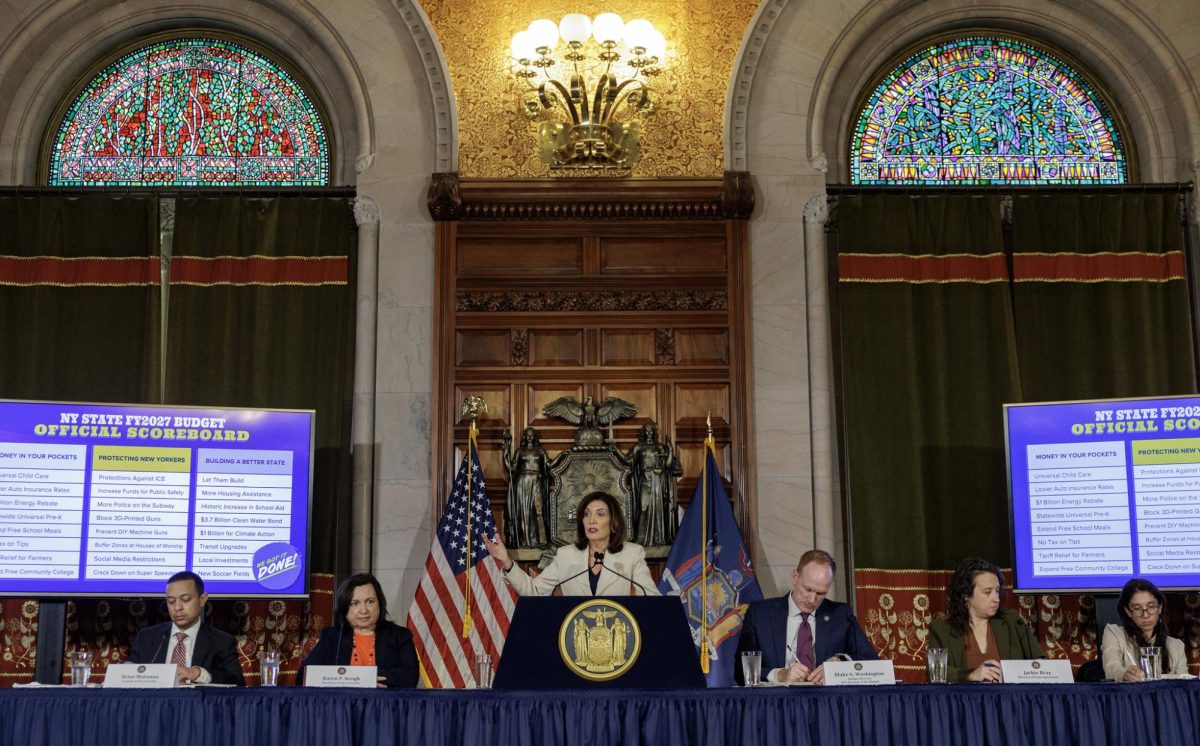
On March 31, state legislatures passed the first budget extender of 2026, avoiding a government shutdown amidst the looming April 1 deadline on the budget vote for the 2026-27 fiscal year. A budget extender temporarily enables lawmakers to keep government operations running and avoid a shutdown when a finalized budget deal fails to be made by its deadline. Since the passage of the initial budget extender, five others have passed throughout April, with the most recent being approved by Governor Hochul on April 22.
The state fiscal year budget being delayed is nothing new: Last year, 12 extenders were passed before the 2025-26 fiscal year budget was approved in May. The current budget delay is nowhere near the record set by legislatures back in 2004, when a consensus was finally reached 133 days after the initial due date. That historic record was achieved during former Governor George Pataki, whose tenure notoriously oversaw consistently late budget package votes. Eliot Spitzer, Pataki’s successor, ended a 20-yearlong streak of chronic budget lateness; albeit packages under Spitzer’s governorship were fulfilled after last-minute negotiations. Spitzer’s two-year stint as governor offered just a short hiatus to the budget being approved on time. In Former Governor David Paterson’s last year in office in 2010, the spending plan was finally approved on August 3, 125 days late.
Under Hochul, the budget has been late every year since she took office in 2021. The latest that a budget was approved under Hochul came last year, when a deal was finally reached 38 days later on May 9. The closest that legislatures came to reach the annual April 1 deadline was in 2022, when the budget passed eight days later.
This year, non-monetary issues are the main reasons for the late budget vote. Notably, Hochul finds the 2019 Climate Leadership and Community Protection Act (CLCPA), which aims for a 40% reduction in greenhouse gas emissions by 2030 and 100% zero-emission electricity by 2040, as a liability.
“We cannot meet the Climate Act’s 2030 targets without imposing new and additional crushing costs on New York businesses and residents,” Hochul wrote in a late March op-ed. Hochul is now arguing to weaken CLCPA regulations and to push back deadlines for reducing greenhouse gas emissions, the first of which is in 2030.
The budget process’ lag has caused anger among several legislators. On April 23, Assembly Speaker Carl Heastie was “clearly frustrated” by the spending plan’s tardiness, saying to his fellow legislators, “There is something wrong with this process, and you all don’t write about it.” Assemblymember Phil Steck (D-110) has blamed Hochul for not reaching an agreement with the legislative leaders. “The governor is talking about concepts, but without proposing language,” Steck told CBS6 on April 20.
The current budget extender lasts until April 27. If an agreement cannot be reached by legislators, then a seventh extender will have to be approved.