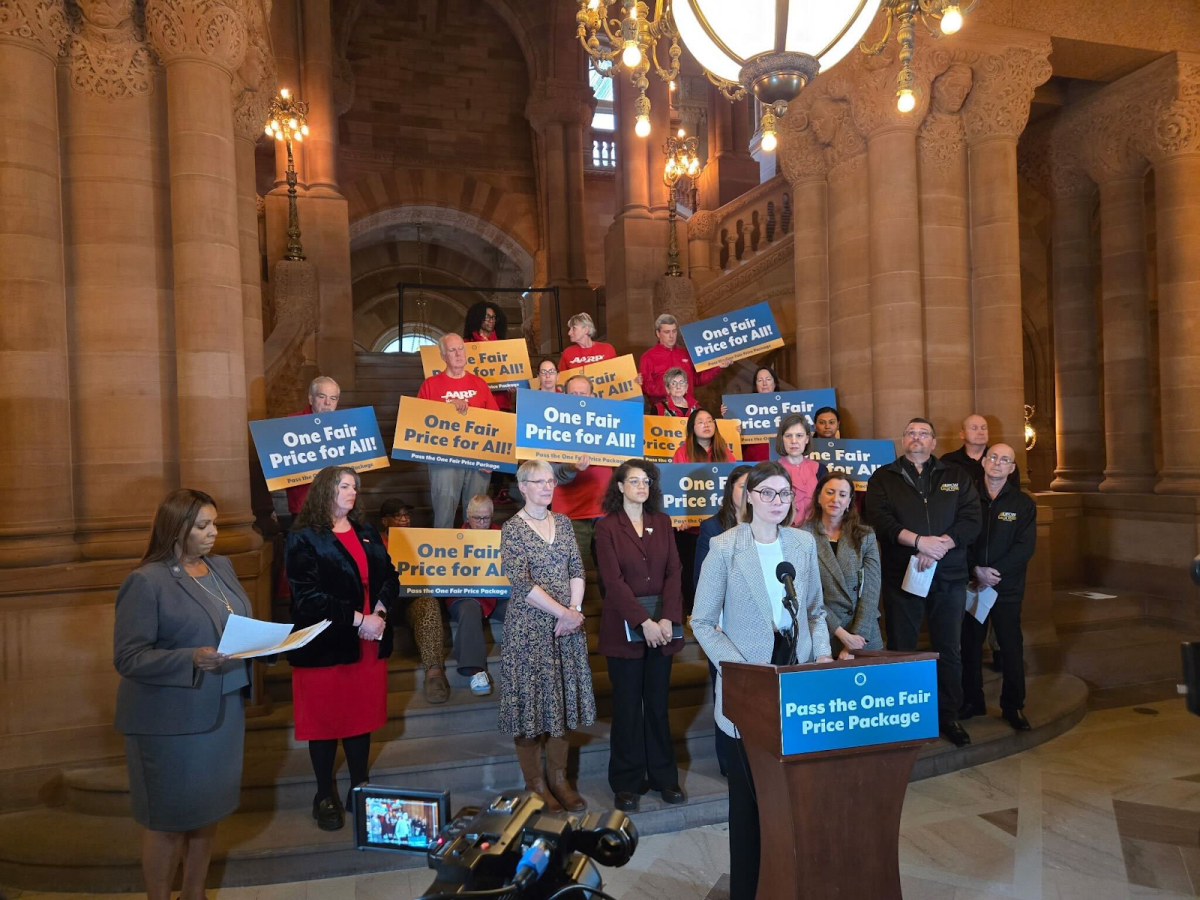
On Monday, March 16, a rally at the Million Dollar Staircase took place to garner support for the “One Fair Price” package – two bills that would ban surveillance pricing and electronic shelf labels in New York.
These practices are examples of algorithmic pricing, a recent technology backed by AI and automated software that adjusts a product’s price based on consumer demand, competitor prices and inventory. While some industries claim that algorithmic, or surveillance, pricing benefits consumers, many economic experts and state senators believe that the technology is harmful, especially amid the U.S.’s affordability crisis.
Groundwork Collaborative’s Liz Pancotti spoke to the Legislative Gazette following the event. Pancotti, who serves as the organization’s Managing Director of Policy and Advocacy, has been involved in investigations after large corporations such as Walmart and Instacart have been exposed in implementing algorithmic pricing on popular products.
In Instacart’s case, many of its consumers spent upwards of $1,200 more per year than the average family of four from unknowingly consenting to the delivery company’s pricing experiments. Despite Instacart profiting from integrating algorithmic pricing, employees and drivers who are independently contracted have not seen an increase in their wages.
“These algorithms are kind of a black box,” said Pancotti. It’s quite unclear what you as a driver versus what I as a driver would make, even if we were picking up the exact same number of items from the same store at the same time, driving the same distance.”
Instacart is far from the only company under scrutiny for manipulating prices. According to Pancotti, companies that offer similar services to Instacart, like Uber, Lyft, and DoorDash, “are using the same tactics.”
Apart from the food delivery sector, companies such as those from the ticket selling industry have also been under fire. On Sept. 18, 2025, The Federal Trade Commission (FTC) sued Ticketmaster and its parent company, Live Nation, alleging that the company “willingly misleads consumers about ticket prices and cooperates with scalpers to markup resale prices.”
Algorithmic and surveillance pricing bills like those in the One Fair Price package have popped up around the country. On March 8, Pennsylvanian senators amended the state’s Senate Bill 1205 to prohibit companies from changing their products’ prices during a 24-hour period: Hawaii, Maryland and New Jersey, among a couple of other states, are currently making similar efforts.
“There are also federal efforts to regulate electronic shelf labels,” added Pancotti.
In New York, Deputy Majority Leader Michael Gianaris and Assemblymember Michaelle C. Solages (D-22) are seeking passage of the Protecting Consumers and Jobs from Discriminatory Pricing Act, which would prohibit the uses of both electronic shelf labels and surveillance pricing in pharmacies and grocery stores.
Other notable figures present at the March 16 rally include Attorney General Letitia James, State Senator Rachel May (D-48) and Assemblymember Emérita Torres (D-85). May and Torres are co-sponsors of the One Fair Price Act.