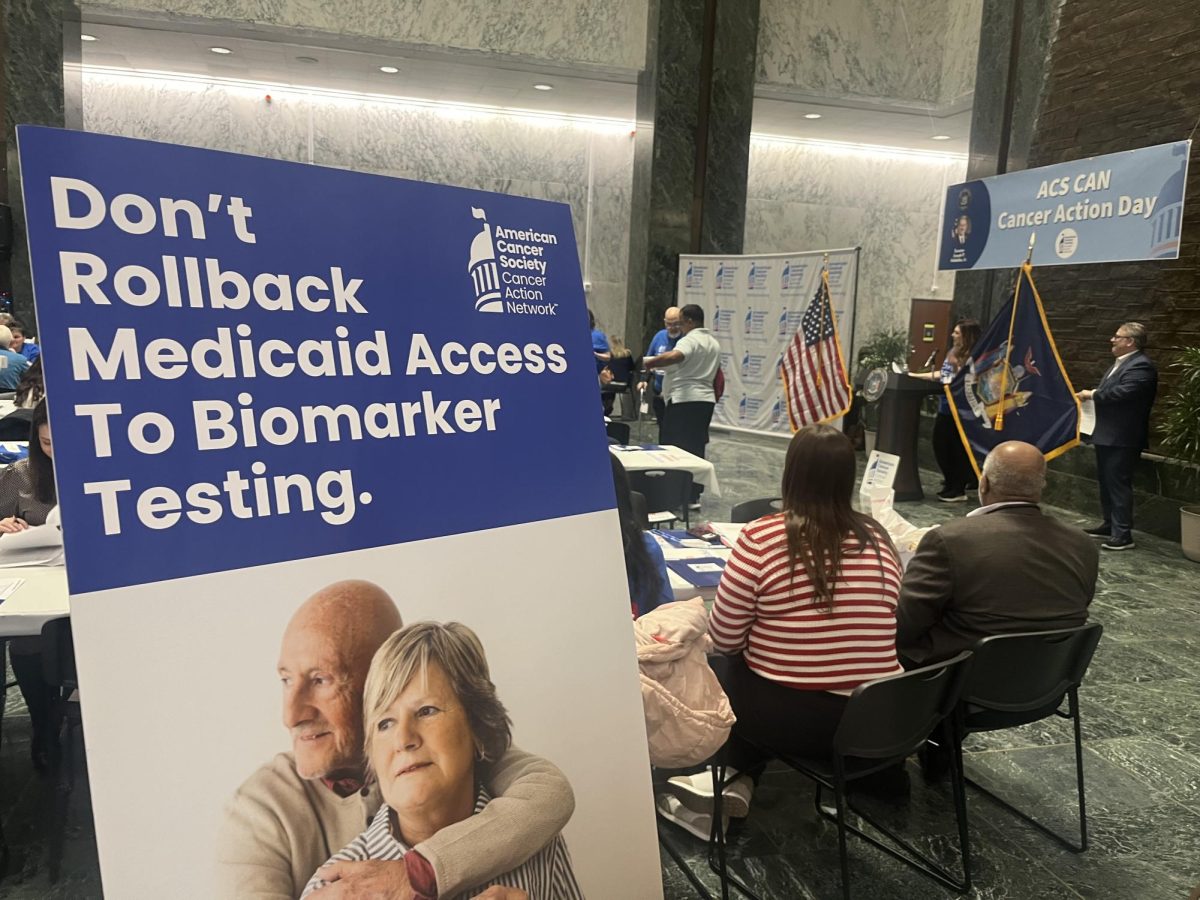
On April 21, many cancer survivors, medical professionals and patient advocates gathered at the New York State Capitol for the annual “Cancer Action Day.” Cancer Action Day is an annual advocacy event hosted by the American Cancer Society Cancer Action Network (ACS CAN), where patients, survivors and volunteers meet with lawmakers to prioritize cancer-related policies.
The purpose of this year’s Cancer Action Day was to ensure that Medicaid enrollees can maintain access to biomarker testing, a critical resource in the fight against cancer. Cancer biomarker testing, also known as molecular or genomic testing, analyzes tumor tissue, blood or fluids to identify specific genes, proteins or mutations driving cancer growth.
At a press conference kicking off the event, Michael Davoli, ACS CAN’s New York senior government relations director, introduced himself and outlined his hopes for the future of cancer patients in New York. ACS CAN advocates for evidence-based public policies to reduce the cancer burden for everyone, engaging volunteers across the country to make their voices heard by policymakers at every level of government.
Also speaking was Rebecca Oechsner, ACS CAN’s regional senior manager for grassroots organizing. She also addressed biomarker testing. According to ACS CAN research, cancer patients and survivors overwhelmingly agree that biomarker testing improved their treatment. A survey found that about half (49%) of those surveyed had biomarker testing for their cancer, while 29% said they had not and 22% were unsure, an increase from 39% in 2020. Those most likely to have had biomarker testing include younger patients, those with higher incomes and those with higher educational attainment. Among those who had biomarker testing, 84% said their provider initiated the process and 14% reported asking for the test themselves. Oechsner expressed hope that biomarker testing will improve outcomes for cancer patients.
Three cancer patients — Lili Bazargan, Andrew Mainwaring and Edward Edelman — shared their personal experiences living with the disease. Mainwaring and Edelman both spoke about their struggles with prostate cancer.
“It was a lot,” Mainwaring said. “Living with cancer is a struggle. It took a lot out of me, and it impacted my family, with them being concerned for my well-being. I can only hope that through this new biomarker testing, outcomes improve so that no one would have to go through this same struggle.”
All three advocates expressed hope that the passage of two proposals would benefit others who have suffered from cancer. One proposal would update New York’s Paid Family and Medical Leave program, which currently does not provide New Yorkers facing disease or caring for a loved one with a livable wage. A second proposal would connect more New Yorkers to patient navigation, a personalized health care delivery service that helps patients navigate the complex health care system and receive timely care.