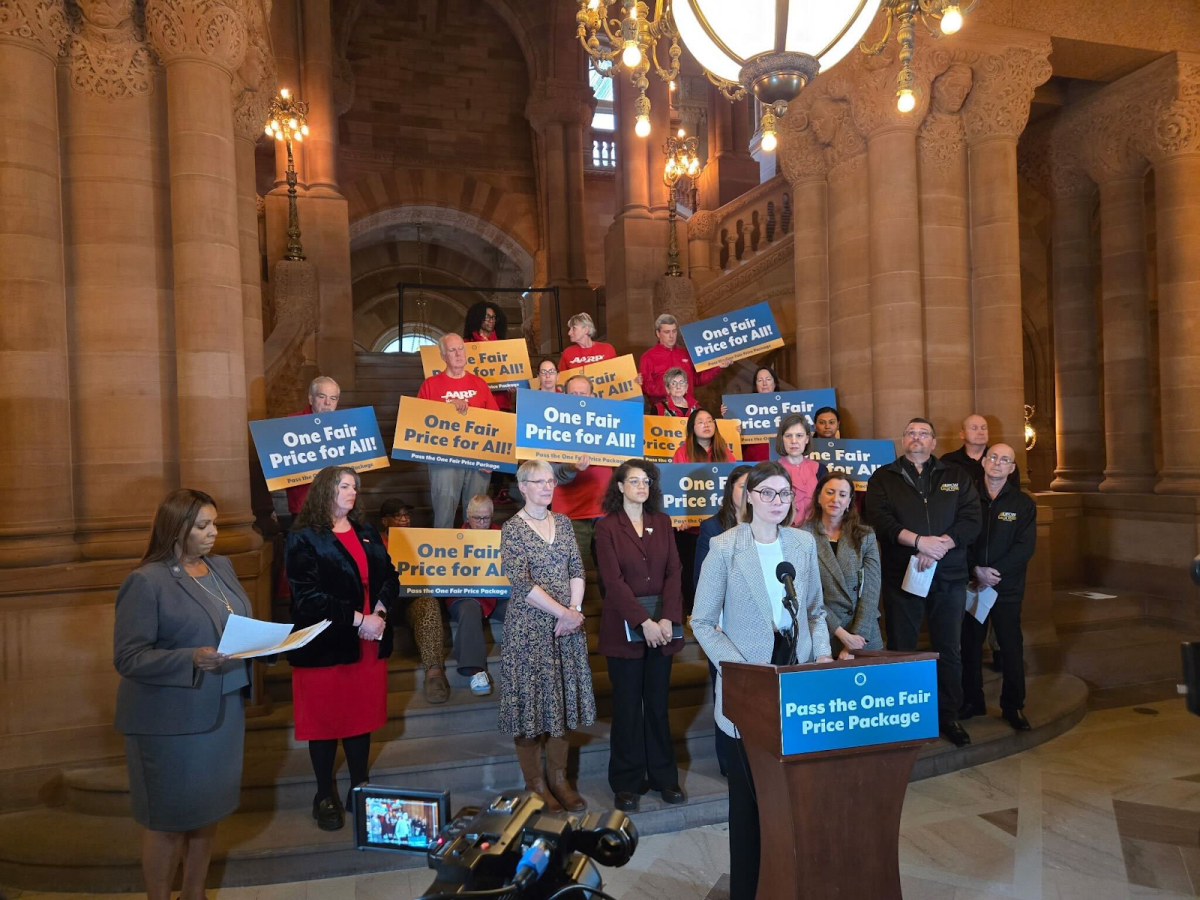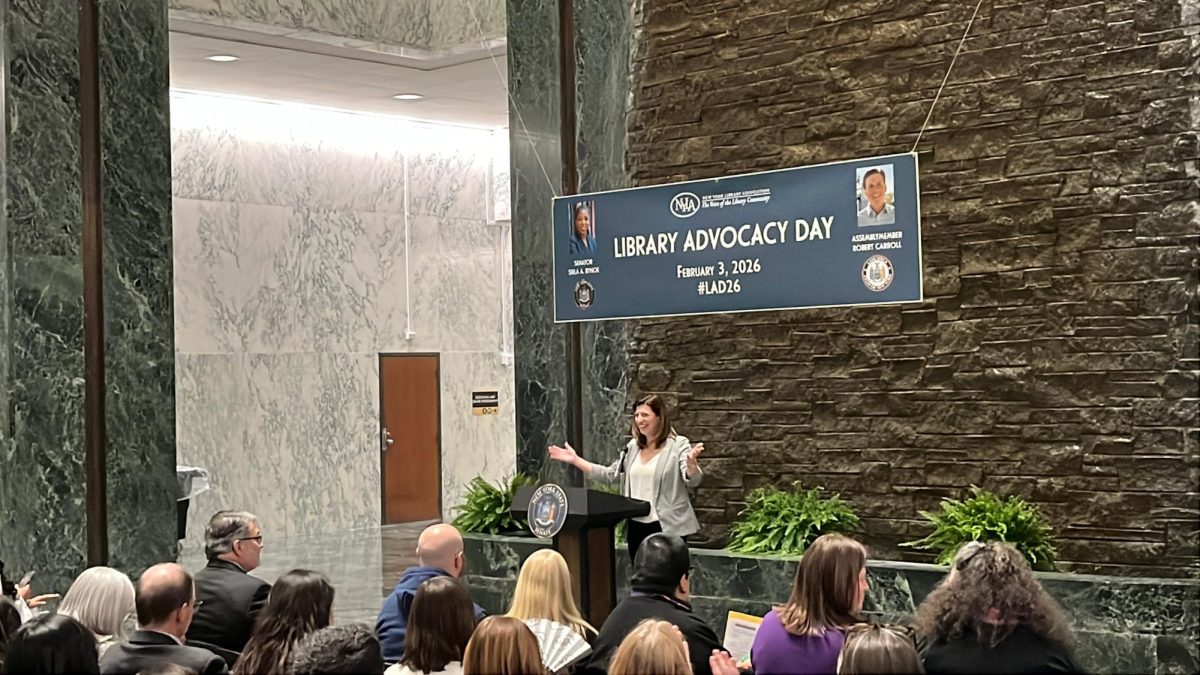
On February 3, library advocates from across the state filled The Well of the Legislative Office Building at the New York State Capitol, pressing lawmakers to prioritize public library funding and policy protections in the 2026 state budget.
The annual advocacy day, organized by the New York Library Association (NYLA), brought together librarians, trustees, educators and supporters for meetings with legislators, followed by a rally designed to energize their coalition and underscore the stakes of ongoing budget negotiations.
The message was direct: New York’s libraries need sustained investment and stronger legal protections to meet growing demand and to guard against censorship pressures.
A $382 Million Ask
In advance of the event, NYLA circulated a detailed legislative agenda outlining both funding requests and policy priorities.
At the top of the list is $181.32 million for the state’s library operating budget, a figure the association says would maintain statutory support for core services such as eBook access, interlibrary loan systems and coordinated collection development.
NYLA is also seeking $175 million in construction aid, funding that supports renovations, expansions, accessibility upgrades and the acquisition of new spaces. Advocates argue that many library buildings are aging and in need of modernization to serve as community hubs, technology centers and emergency resources.
For schools, the association is requesting $11.33 per pupil in library materials aid, direct funding intended to strengthen school library collections and technology access. The allocation would support textbooks, digital resources, hardware and equipment, with an emphasis on ensuring equitable access regardless of students’ economic background.
Another priority is $3.1 million for NovelNY, the statewide digital database program administered by the New York State Library. NovelNY provides residents with free access to academic journals, research databases, magazines and reference materials that would otherwise require costly subscriptions.
NYLA is also calling for $12 million for the Office of Cultural Education, which oversees the State Library, State Archives, State Museum, the Summer School of the Arts and the Public Broadcasting Program.
Combined, the proposals represent a sweeping investment in both the physical infrastructure and intellectual resources of New York’s library system.
Policy Beyond the Budget
While funding dominated the day’s meetings, advocates also pressed lawmakers to back several policy initiatives.
Chief among them is legislation to protect intellectual freedom in libraries, a response to rising challenges to books and educational materials nationwide. NYLA is urging lawmakers to enact safeguards that defend library professionals from censorship pressures in both public and school settings.
The association is also advocating for eBook licensing reform, seeking legal protections against restrictive or exploitative terms imposed by publishers on digital materials. Librarians argue that current licensing models often inflate costs and limit access compared with print purchases.
Other priorities include expanding media literacy education in New York schools and formally recognizing Certified Library Media Specialists as leaders in that work. Advocates contend that in an era of online misinformation, libraries and school media specialists play a critical role in teaching students how to evaluate sources and engage responsibly with information.
Finally, NYLA is pushing for civil service reform to address hiring and retention challenges that have strained library staffing across the state.
Rallying Support
The day concluded with a rally in The Well, where NYLA leaders and supportive lawmakers delivered remarks to a packed crowd.
NYLA Director of Government Relations and Advocacy Max Prime and NYLA President Ginger Tebo opened the event by framing libraries as essential civic infrastructure. “We’re here because libraries matter,” Tebo said, linking that mission directly to media literacy and equitable access to information. “Media literacy is access and equity.”
Among the lawmakers who addressed supporters were State Sens. Siela A. Bynoe and Dean Murray, both members of the Senate’s Libraries Committee. Bynoe serves as chair of the committee.
Bynoe praised library professionals for sustaining and expanding services in their communities. Library patronage continues to grow, she noted, crediting staff members for their day-to-day work connecting residents with information and resources.
Murray echoed the theme of long-term investment. “When they say libraries matter, they don’t just matter — they are vital,” he told the crowd. Funding libraries, he argued, should be viewed not as an expense but as an investment in the state’s future.
Assemblymember Robert Carroll, chair of the Assembly Committee on Libraries and Education Technology, was not present but was identified by advocates as a legislative ally.
A Broader Political Context
This year’s advocacy day comes just two months after Gov. Kathy Hochul vetoed the Freedom to Read Act, legislation that had passed both chambers of the Legislature. The bill focused largely on catalog management policies in public school libraries and was championed by supporters as a measure to shield students’ access to diverse materials from viewpoint-based challenges.
In the wake of the veto, the New York Civil Liberties Union criticized the decision, calling it a missed opportunity to combat censorship and protect students’ rights.
Though the veto represented a setback for library advocates, speakers at the rally struck a tone of determination rather than retreat. The budget requests and policy priorities presented this week reflect a broader effort to reinforce libraries as pillars of democratic access — institutions that provide not only books, but technology, research tools, cultural programming and safe public space.
As budget negotiations continue in Albany, NYLA members say they will maintain pressure on lawmakers to meet their funding targets and adopt legislative protections. For advocates gathered beneath the Capitol’s high ceilings, the argument was clear: investing in libraries is investing in the next generation.
“The most important thing you do,” Bynoe told library professionals, “is intrigue young scholars.” Today’s readers, she added, are tomorrow’s leaders.